
Into the Gayakwad dynasty
The Laxmi-Vilas Palace
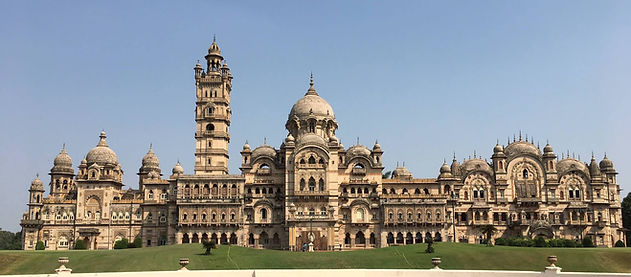
Once for The Kings, Now for All.
Though I have visited Baroda so many times, I did not manage to visit the marvelous monument, The Laxmi Vilas Palace. It was on my to-visit list for around 4 years. I somehow managed to visit the palace last Sunday with my cousin. We were at the palace at 10 in the morning. We registered our names at the gate no.2.
You have to pay 225 rupees for a person as a fee to visit the palace. An audio guide is included in the fee. It is available in different languages, Gujarati, English, Hindi and Marathi. The ticket was too beautiful. They designed it as a post card and photo of palace on it.
The palace was divided into 10 parts for visitors as The Sunken Garden, Entrance Hall, Armory, Coronation Hall, Darbar Hall etc. I don't remember all names.
First point of visit. The sunken garden. The sunken garden overlooks a massive golf course and it is a good point to capture panoramic shots of the palace. We took so many, as photography is only allowed outside the palace.If you stare at palace carefully as I did with my eye wide open, you will come to know that both sides of the palace is not identical as a common practice. The sunken garden had a round pool, which provides a reflection of the palace in it. But there was no water in it. My bad luck.There are two life-sized bronze sculptures by famous Italian artist Fellici Casorati. You will hear this name so many times during an audio tour.
Then comes an entrance hall. Hall has statues carved on the walls. There were two marble, bronze sculptures by Felicia, one of a Brahmin and a another of a nobleman. Don't forget to look up. Yes, it's Beautiful Belgian chandeliers.
After the entrance hall there are pillars, cow and sun carved on it. So at this place if you are concentrating on audio also, you will hear, from where the Gaekvaad name came. An ancestor once saved a cow(Gau) from getting slaughtered by tying it to his door (kivaad), thereby declaring that it was protected. Gau+Kivaad thus became Gaekvaad… Pretty interesting. Isn't it?
After you climb two steps up, there's beautifully carved staircase in the Entrance hall. And guess who carved it, Fellici Casorati. Above the staircase there is a beautiful peacock made of mosaic tiles on the wall.
You will hear, of course in audio guide, how king likes this palace, how strict the schedule was, how they played in that lobby, how much time they have to wait for a tea, how much distance they have to cover to go to the bathroom and the lists go on. Horse riding at 5 in the morning everyday!:o A nice guest room was there with the life size paintings of kings and queens hanging on the walls. They have painting of their nurse in the lobby. :)
The Armory. Here comes the best part of the palace. This is the room where I have spent maximum time observing every detail of every weapon showcased there.So many types of swords! You will get amazed when you come to know that all these weapons were used in the battles at one point or another. Chakras, semi machine guns, daggers, armors made from the skin of tortoise and hippos, weapons made up from elephant tooth (or teeth?). The best thing was Guru Govind Singh's versatile weapon and sword of Aurangzeb.
After googling, I came to know Guru Govind Singh fought the battles against the mughal emperors. Two of them were against Aurangzeb.
1.First Battle of Anandpur (1700), against the Mughal army of Aurangzeb, who had sent 10,000 soldiers under the command of Painda Khan and Dina Beg. In a direct combat between Guru Gobind Singh and Painda Khan, the latter was killed. His death led to the Mughal army fleeing the battlefield.
2.Battle of Nirmohgarh (1702), against the forces of Aurangzeb, led by Wazir Khan on the banks of Nirmohgarh. The battle continued for two days, with heavy losses on both sides, and Wazir Khan army left the battlefield.
And today, both the weapons lay next to each other in the same room. Forgetting the rivalry their owners had, 300 years ago.
The most important place of the palace, 'The Coronation Hall' It is a holy place because the coronation of kings happens there. You have to remove your footwear before entering the hall. The Gadi of the king was so simple with a round cushion on it, under the peacock umbrella. [While writing this I came to realize that I have seen so many peacock sculpture and drawings and mosaic, I think the king was very fond of peacock]
The hall's main attraction is paintings by Raja Ravi Varma. The father of modern Indian art and the artist who gave the vision to Hindu mythology. The goddess Laxmi and goddess Saraswati in your conscious mind is because of this gentleman painter. If you want to know more about him google him or watch movie RangRasiya starring Randip Hooda as Raja Ravi Varma.He stayed in Baroda for 14 years and created some of his best works. You will see many original paintings of him as well as copied paintings of him. In the paintings from him, you will see, Shankuntla, Radha Krishna, Sugandha and others I have no name for them.
But don't forget to observe the detailing done in every painting and every carving. In the carving, there's a story or philosophy behind every curve and pattern. :p
The Darbar Hall:
I don't want to describe its beauty. It is a rectangular room with very high ceiling from which many Belgian chandeliers are hung. The hall has no pillar supporting the ceiling. The windows are decorated with stained glass, depicting scenes from Hindu mythology, letting the rays of the eastern sun filter to the floor. In the words of the king himself, “There is perhaps no finer room in India.” Photographs of queen is addition to the beauty of the hall. Please go and visit the palace. The Belgian chandeliers were covered with white cloth.Again my bad luck. I have seen them with light on the Wikipedia page of the palace.They look great at night.
There is lite refreshment stall just outside the Darabar Hall, don't expect something royal as I expected. We asked for Lassi in hope to get the Royal Lassi, but when the guy handed us the tetra pack of Amul Lassi and charged double than MRP, all my royal feeling was (I have no word, you know the feeling :p).
If you happened to be in Baroda or staying near Baroda, please visit the place. It takes hardly 2-3 hour to see the palace. Audio guide is about 1 hour only.
At the gate number-3, there is a Fatesingh Museum also. Once it was schools for the princes. Now they have converted into the museum. It's also a nice place to visit. 80 Rs entry fee plus extra charges for audio guide.
In the garden of the museum, there is The Flying Scotsman train’s engine. King has gifted this little version of the original flying Scotsman train to his children to roam around the palace and to visit the school. The engine is kept at the museum and the other part of the train is the train we see in the sayaji baug.
If you have an interest in art, sculpture and paintings, you must visit it.
Some Facts from the internet and Audio Guide:
1. The palace houses 170 rooms and was built just for two people, the Maharaja and the Maharani.
2. It took 12 years for its completion.
3. It was designed in Indo-Saracenic style by the architect Major Charles Mant and later after his death it was completed by Robert Fellowes Chisholm. Major Charles Mant being a perfectionist, came to a conclusion that his calculations were wrong and hung himself assuming the palace would not last long. However the palace stands strong, even after 125 years.
4.The front façade of the palace is designed in an eclectic architectural style blending Moghul, Jain, Rajput, Marathi, Gujarati as well as Gothic and Venetian designs harmoniously.
5. It is considered as one of the most expensive palaces built during the time of its completion with a total cost of approximate £180,000.
6. The palace has a 300 ft tower, which was meant to be a clock tower, but the idea was not implemented since the constant ticking would be a disturbance for the residents. Instead, a lamp was installed that would light up bright red to indicate the king was in residence. This practice is followed even today and additionally, a saffron flag is hosted on the main entrance gate of the palace to signal to the people of Baroda that the king is in residence.
7. Laxmi Vilas Palace has the maximum number of stained glass ever used in a palace.
Guards were very friendly. If you can go against the rules and your ethics you can capture the photographs inside the palace if a guard is not around.
Go visit and share your experience with me.
Thanks for all the hospitality Ankit and Dharabhabhi.
Thanks Jigar for accompanying me in the palace.